
For developers in specific web environments, Google's newly released AI IDE -- the Antigravity, delivering a rather ironic experience: the software interface is designed with minimalist elegance and starts up quickly, but the core functionality is completely paralyzed.
The most typical symptom is this: the UI renders perfectly when you start the software, but when you try to log in to your Google account or do code completion, the interface locks up in the “Authenticating”(Validating) status, or the model loading indicator is stuck in an infinite loop. This means you can't log in and you can't use any AI features.
It's not Google's services that are down, nor is your network completely disconnected. This is actually a typical Windows process isolation issuesInstead of brute-force turning on system-level TUN mode (taking over all traffic), a more precise "surgical" configuration is needed. Instead of brute-force system-level TUN mode (which takes over all traffic), a more precise "surgical" configuration is the answer.
Core foci: the forgotten "shadow process"
To understand why a browser can access Google and Antigravity can't log in, you first need to look at the software's architecture, which utilizes a front-end/back-end separation common to modern IDEs:
- Frontend: The beautiful interface that the user sees is essentially an Electron container. It usually inherits the system's HTTP proxy settings.
- Backend: Independent sub-processes that are actually responsible for heavy tasks.
While users are staring at the spinning loading circle, there is actually an unknown "laborer" in the background that is constantly trying to connect to the Google Cloud and hitting the wall. The culprit is:
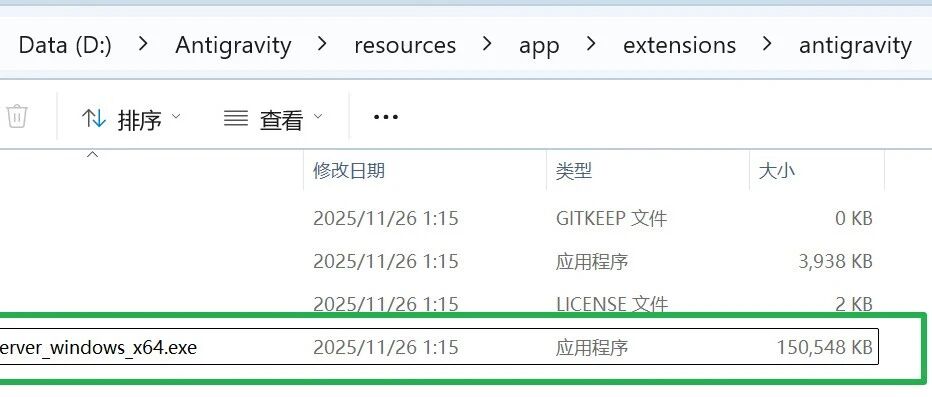
language_server_windows_x64.exe
It is buried deep in the belly of the installation catalog:
antigravity/resources/app/extensions/antigravity/bin/language_server_windows_x64.exe
This is a standard LSP (Language Server) process. When you open the IDE, it's responsible for setting up gRPC tunnels to Google's infrastructure, handling authentication, intelligent analysis of code, and communication with the Gemini Model communication.
Troubleshooting: why doesn't it go proxy?
Analyzing it with Proxifier or a similar web crawler tool clearly shows the root cause of the error. The logs show that the process is trying to connect directly to Google Cloud Code's private API endpoint:
[12.04 16:21:26] language_server_windows_x64.exe (17280) - daily-cloudcode-pa.sandbox.googleapis.com(142.250.99.81):443 error : connection attempt failed with error 10060
Error Code 10060 means that the connection timed out.
The crux of the matter is that this Native Binary, derived from Antigravity, oftenNo automatic inheritanceenvironment variable of the operating system or browser proxy setting. It tries to initiate a direct connection request, which is blocked by the firewall. This explains why your browser (and even parts of the IDE's web interface) can access the internet, but the core login and AI functions are offline.
Solution: Precision Process Agent (no need to enable TUN)
Many tutorials recommend turning on the VPN's TUN mode to force it to take over all system traffic. While effective, this approach is akin to "burning down the house to kill a mosquito" - it interferes with gaming, LAN sharing, and other domestic application connections.
A more elegant solution would beProcess-Based ProxyingWe just need to tell your proxy software, "Keep an eye on this particular EXE file. We just need to tell your proxy software: "Keep an eye on this particular EXE file and take over its traffic."
procedure
Whether you're using Proxifier, Clash Verge, or another client that supports rules mode, the core logic is the same:
1. Locating the target document
First, you need to find the absolute path to the file. It is usually located in the Extensions folder in the Antigravity installation directory:
antigravity/resources/app/extensions/antigravity/bin/language_server_windows_x64.exe
2. Adding proxy rules
In your web tool, create a new rule (Rule):
- Process Name:
language_server_windows_x64.exe - Strategy (Action/Proxy): Select the Proxy Group you have available.
take note of: It is not necessary to change the main program Antigravity.exe Join the rules, because it's usually only responsible for rendering the UI. What we need to "save" is the backend process that's responsible for the language service.
Validation of results
Once the rule is in effect, there is no need to reboot the system, just restart the Antigravity software:
- Authenticating The prompt will quickly disappear and the login will be successful.
- A record of the process successfully establishing an HTTPS/gRPC connection appears in the background log.
- AI Code Completion and Chat features will be back to responding instantly.
In this way, developers can pinpoint Antigravity's waterlogging problems while keeping the system's network environment clean (no global TUN required). This proves once again that when dealing with complex modern development tools, localizing to the underlying process through logs is often much more effective than blindly modifying system settings.