
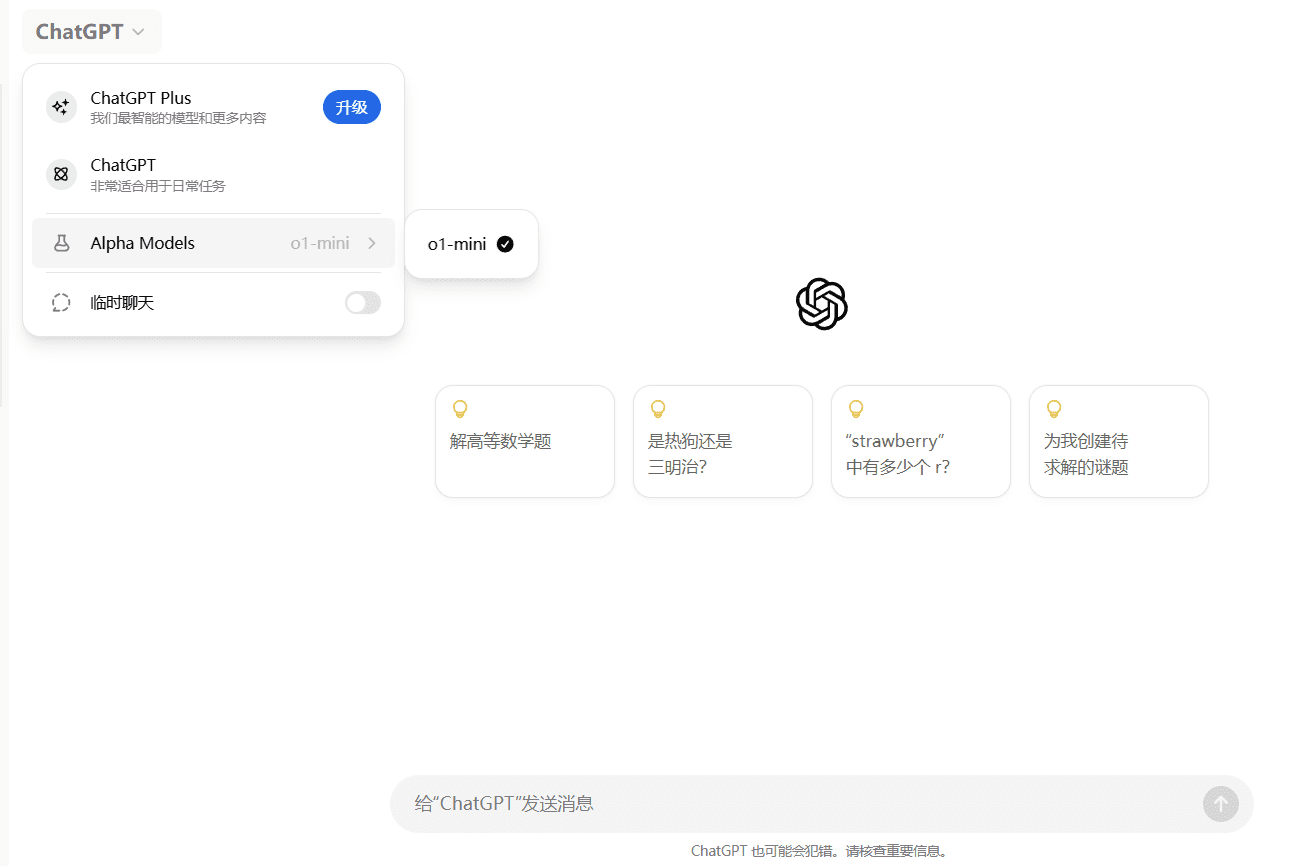
The o1 family of models are advanced process reasoning models, of which the small-sized o1-mini model has the potential to be stronger than o1-preview in terms of logical reasoning, although the world knowledge capability has been curtailed.
Currently o1-mini is only open to some free accounts for preview experience. Whether your account officially opens the o1-mini model can be verified with the following decoding questions:
oyfjdnisdr rtqwainr acxz mynzbhhx -> Think step by step
Use the example above to decode:
oyekaijzdf aaptcg suaokybhai ouow aqht mynznvaatzacdfoulxxz
The above validation question comes from OpenAI o1 Reasoning Ability Learning for Large Language ModelsFor more information on the o1-mini model, please read the following article. Introduction to the OpenAI o1-mini Large Model。
If you don't have a ChatGPT free account or lack access to the o1-mini experience, you can visit:ChatGPT Mirror Station (domestic access to GPT4 series models) Experience.
Some concerns about the OpenAI o1 model
Model names and inference patterns
- OpenAI o1 represents a new level of AI capability and the counter is reset to 1
- "Preview" indicates that this is an early version of the full model.
- "Mini" indicates that this is a smaller version of the o1 model, optimized for speed
- o - on behalf of OpenAI
- o1 is not a "system" but a model that trains students to grow the chain of reasoning before providing the final answer.
- The icon of o1 symbolically represents an alien with extraordinary abilities
o1 Model size and performance
- o1-mini is smaller and faster than o1-preview, so it will be available to free users in the future
- o1-preview is an early checkpoint in the o1 model that is neither too big nor too small
- o1-mini performs better in STEM tasks but is limited in world knowledge
- o1-mini performs well in some tasks, especially in code-related tasks, better than o1-preview
- Inputs for o1 Token is calculated in the same way as GPT-4o, using the same Tokenizer
- Compared to o1-preview, o1-mini can explore more chains of thought
Input Token Contexts and Model Capabilities
- o1 models will soon support larger input contexts
- o1 model can handle longer, more open-ended tasks, with less need to chunk inputs as in GPT-4o
- o1 can generate long chains of reasoning before providing an answer, unlike previous models
- It is currently not possible to pause inference during CoT inference to add more context, but this feature is being explored in future models
Tools, Features and Upcoming Features
- o1-preview does not currently use tools, but plans to support function calls, code interpreters, and browsing capabilities
- Tool support, structured output and system hints will be added in future updates
- Users may eventually be able to control thinking time and Token limits
- Plans are underway to support streaming processing and consider reflecting inference progress in the API
- The multimodal capabilities of the o1 have been built in with the goal of achieving state-of-the-art performance in tasks like MMMUs
CoT (chain of reasoning) reasoning
- o1 Generating hidden inference chains during inference processes
- No plans to expose CoT Token to API users or ChatGPT
- CoT Token will be summarized, but there is no guarantee that it will be fully consistent with the actual reasoning process
- The instructions in the prompt can influence the way the model thinks about the problem
- Reinforcement learning (RL) was used to enhance the CoT capacity of o1, whereas GPT-4o was unable to achieve its CoT performance through cueing alone
- While the reasoning phase may seem slower, it is actually usually faster to generate an answer because it summarizes the reasoning process
API and usage restrictions
- o1-mini has a weekly limit of 50 prompts for ChatGPT Plus users
- All cues are counted the same in ChatGPT
- More API access tiers and higher limits to be rolled out over time
- Hint caching in APIs is a hot demand, but no timeline yet
Pricing, fine-tuning and expansion
- o1 Model pricing is expected to follow a downward price trend every 1-2 years
- Volume API pricing to be supported as restrictions increase
- Fine-tuning is planned, but the timetable has not yet been finalized
- o1 Expansion limited by bottlenecks in research and engineering talent
- New Extended Paradigm for Inference Computing May Lead to Significant Improvements in Future Generations of Models
- Reverse extensions are not significant at this time, but o1-preview performs only slightly better (or even slightly worse) than GPT-4o on individual writing prompts
Model Development and Research Insights
- o1 Reasoning skills through intensive learning training
- The model demonstrates creative thinking and excels in lateral tasks such as poetry
- o1's philosophical reasoning and broad reasoning skills are impressive, such as deciphering codes
- o1 was used by the researchers to create a GitHub bot that pings the right CODEOWNERS for code reviews
- In internal testing, o1 posed difficult questions to itself to assess its ability to
- Extensive world domain knowledge is being added and will be improved in future releases
- Plan to add updated data for o1-mini (currently October 2023)
Tips Tips and Best Practices
- o1 Benefit from providing tips on edge cases or reasoning styles
- o1 models are more receptive to reasoning cues in cues than earlier models
- Providing relevant context in Retrieval Augmented Generation (RAG) improves performance; irrelevant fragments may weaken inference
General feedback and future improvements
- o1-preview is less restrictive due to being in an early testing phase, but will increase the number of
- Latency and inference times are being actively improved
Significant modeling capabilities
- o1 can think about philosophical questions such as "What is life?"
- Researchers find o1 excels at handling complex tasks and extensive reasoning from limited instructions
- o1's creative reasoning skills, such as assessing their abilities by asking their own questions, demonstrate a high level of problem solving skills